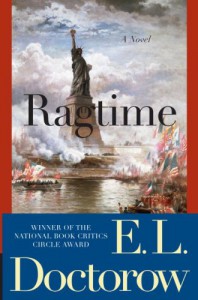
I loved a music survey course I was required to take in college. I learned to love Josquin Des Prez and Monteverdi and Bach and Mozart and a whole passel of composers until we reached Schoenberg, when my first thought was "You've Got to be kidding; this is garbage." I felt the same way upon reading the very first paragraph of Doctorow's Ragtime. Well, except at least Schoenberg was original, while with Doctorow I could see the modernist strands of Hemingwayesque uber-spare prose, Faulknerian stream-of-consciousness, and whoever is responsible for making it a sign of genius to omit quotation marks. Truly, you can tell I think if this novel is for you just from that first paragraph.
It might sound perverse to take a book's measure from it's first paragraph--but it was a long paragraph--three pages long. We're introduced to the central family of the novel, referred to only as "Father," "Mother," "Grandfather," "Little Boy," and most important, "Mother's Younger Brother." It's not a unified topic-sentence kind of paragraph either, but this long incoherent meandering melange mentioning, along with the fictional family, a potpourri of historical figures from the turn of the 20th Century. Here's a snatch of that paragraph that was typical of the syntax: "On the roof. There were screams. Evelyn fainted." Oh, and not only wasn't dialogue not offset by quotation points, but unlike Cormac McCarthy or Charles Frazier, Doctorow doesn't even deign to set each speaker off with different paragraphs.
I found this book an unreadable mess. One of the worst novels I've ever tried reading. I guess I shouldn't be surprised some claim it to be great literature given what I've seen praised, but anyone who tried to tell me they enjoyed this with a straight face? I'd back away slowly.