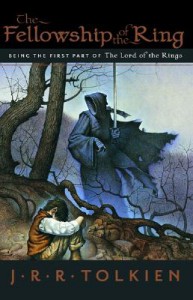
The first thing I should say for those unfamiliar with it, is that The Fellowship of the Ring isn't a self-contained book, one in a trilogy, but the first volume of what was conceived as one novel--thus expect an abrupt ending and have The Two Towers ready to grab. The Lord of the Rings is a "must-try" for anyone who likes fantasy if not a must-read. Not everyone I know who has tried it loves it, (some of my friends greatly prefer The Hobbit) but as someone who has read widely in the fantasy genre, I can tell you no book is more influential in post-World War II high fantasy and there are authors, particularly Brooks and Jordan, that come across as cheap imitations. The work repays second and third readings because of the depth Tolkien gives his world of Middle Earth. According to the introduction, Tolkien had worked out an entire history for Middle Earth before he'd ever written the first volume and it shows. Other made-up worlds seem like painted trees on a drape--Tolkien's trees have roots. This is my third time reading The Fellowship of the Ring and each time I find more in it. I remember reading it for the second time right after the film came out, in the wake of 9/11. Lines had a new resonance for me then. Lines like:
"I wish it need not have happened in my time," said Frodo.
"So do I," said Gandalf, "and so do all who live to see such times. But that is not for them to decide. All we have to decide is what to do with the time that is given us."
Tolkien denies in the introduction that The Lord of the Rings is meant as allegory or topical; he specifically denies that it's inspired by World War II even though it was begun soon after The Hobbit in 1938 and the first volume published in 1954. He wrote he despises allegory and declared we confuse allegory with "applicability." Indeed, that is where I found the power and timelessness of the story--its applicability to my own times where we feel the shadow of history passing over us.
There are antique touches--like Gimli's adoration of Galadriel and how female characters are depicted--notable, especially Goldberry, for their beauty than any other quality. (Although Galadriel is certainly more than a pretty face.) I'm glad the film strengthened Arwen's character by giving her Glorfindel's role. By injecting some heroism in her character it gives us a reason why Aragorn would love her so much beyond her loveliness.
Some complain of Tolkien's style. And I had remembered finding his prose stiff, although this time I was mostly impressed with this part's readability and the glints of humor. Not everything is equally engrossing. Generally, I liked the choices of cuts and compressions the film made. My eyes glazed over at the frequent songs and I skipped over them. The expositional prologue I could have done without. So yes, I have my share of criticisms. But so much shines in this book--not all of which riches you're going to get by watching only the movie: the prodigious imagination, the moving and believable friendships--and that "applicability" of experience.